

Tax Planning and Accounting
Breaking Down the One Big Beautiful Bill: What It Means for You and Your Business
We unpack the most significant changes introduced by the One Big Beautiful Bill, and how they impact you and your business.
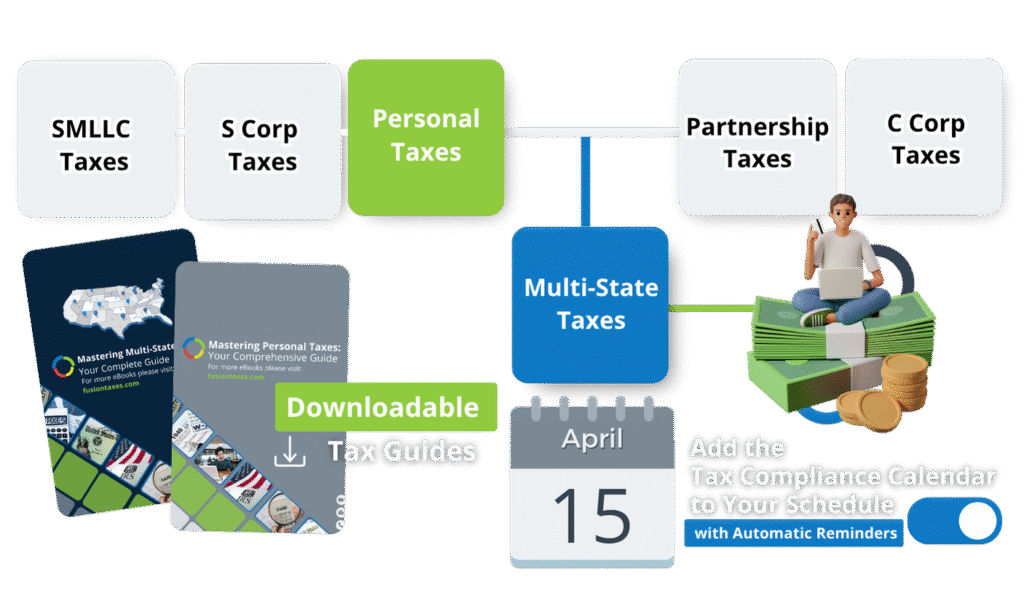







If your business operates on a calendar year, file your 2025 income tax return by this date using the following forms:
C Corporations: IRS Form 1120
Trusts: IRS Form 1041
Individuals: IRS Form 1040
If you need additional time to file your individual return for the 2025 tax year, submit IRS Form 4868 by this date to request a six-month extension. C corporations and trusts may also request an automatic extension using Form 7004 by the same deadline.
C corporations must make quarterly estimated tax payments on April 15, June 15, September 15, and December 15, 2026.







These dates are based on IRS Publication 509 (2026). Deadlines may change if future IRS or state relief is announced.
Visit our business tax deductions calculator to help you understand the deductions your business is eligible for.

Ideally, you want an experienced CPA for tax assistance, as automated services aren’t going to offer the thorough tax planning and preparation that a CPA can. At Fusion CPA we have outsourced, online accountants that are extremely dedicated to what they do.
We use accounting software to streamline your taxes, but we aren’t tied to any specific platforms and offer software integration too. This is valuable when your financial data is spread across a variety of platforms. Because we offer outsourced tax services, you only pay for the help you need!
You can contact one of our client success team to discuss your needs with a real person! If it looks like Fusion CPA is a good fit for you, we will put together a quote. Once you’ve accepted it, we will connect you with one of our expert CPAs.
For individual taxpayers, the tax year is the same as the calendar year, which means that it starts on January 1 and culminates on December 31. Business entities can follow the fiscal year or the calendar year. The question “when is tax season?” typically refers to the period in which tax returns can be sent to the IRS.
Tax filing season for the previous year starts on January 1 and ends with the regular filing deadline of April 15. If happened to be running behind and you had to file an extension then your tax filing is due by October 15.
Business tax returns are due on March 15 for partnerships, and S-corporations. In the case of C-corporations, the deadline is on April 15 if they operate under the calendar year.
Read our extensive blogs as well as some end-of-year tax tips from our CPAs.
Single member limited liability companies taxes are typically filed with the business owner’s personal tax return so the filing deadline is April 15th, and if an extension had to be filed then the tax filing is due by October 15th.
Our clients can get in touch with our office after their tax returns are submitted in order to learn about the status of their refunds.
Alternatively, you can also check the federal government’s website set up for this purpose.
It would take several pages to explain the basics of how tax is calculated in the United States because of the great diversity of taxpayers and their different financial situations. What you should know is that American taxation is progressive, which means that tax assessment levels will increase along with the income you report. Marginal and effective tax rates at the federal level have a lot to do with how tax is calculated; they range between 10% and 37% as of 2021, and they are by no means among the highest in the world.
If we were to boil down tax calculations to a single paragraph it would be as follows:
The most applicable filing status must be ascertained first; this is followed by a determination of all income sources and qualified deductions. These steps result in the calculation of taxable income, but there will be additional workflows to figure out if the overall tax liability can be lowered by means of credits such as education, healthcare, and child care in the case of individual tax returns.
Tax rates are currently 21% on taxable income for US C Corporations, whereas S Corporations and Partnerships remain “flow through” entities and are not subject to Federal tax.
The process is different for business entities because of matters related to equipment, depreciation, payroll, and quite a few others; nonetheless, the common denominator crucial to tax calculation will always be the determination of taxable income. You can read our article explaining US corporate tax rates.
There are several entity structures that businesses can choose from. Each structure comes with its advantages and drawbacks. The entity type that would work best for your business depends on different factors such as the size of your organization, your preferred tax structure, and more. A small business accountant can help you choose the structure that will suit your needs best. This article will explore the most suitable entity structure for your business.
See how the OBBB can benefit your business with a personalized tax strategy crafted just for you.
We unpack the most significant changes introduced by the One Big Beautiful Bill, and how they impact you and your business.
Our team of experienced tax professionals is ready to assist you in navigating complex tax regulations and ensuring accurate filings.
Tailored solutions to meet your specific corporate tax needs, ensuring optimal tax savings and compliance.
Our seasoned tax professionals specialize in multi-state tax regulations, ensuring that you stay compliant with the unique tax requirements of each jurisdiction your business operates in.
We work with clients in diverse industries, but what they all have in common is that they have followed our proven process to reach their goals.

Let’s deep-dive into your unique accounting challenges, streamline a tailor-made timeline, and outline a cost projection, all in one brief, power-packed session.
Our team dives into key data driving business growth, tax strategy, and lean accounting. We examine your software synergy and align a proposal to your unique needs – all in one comprehensive sweep.
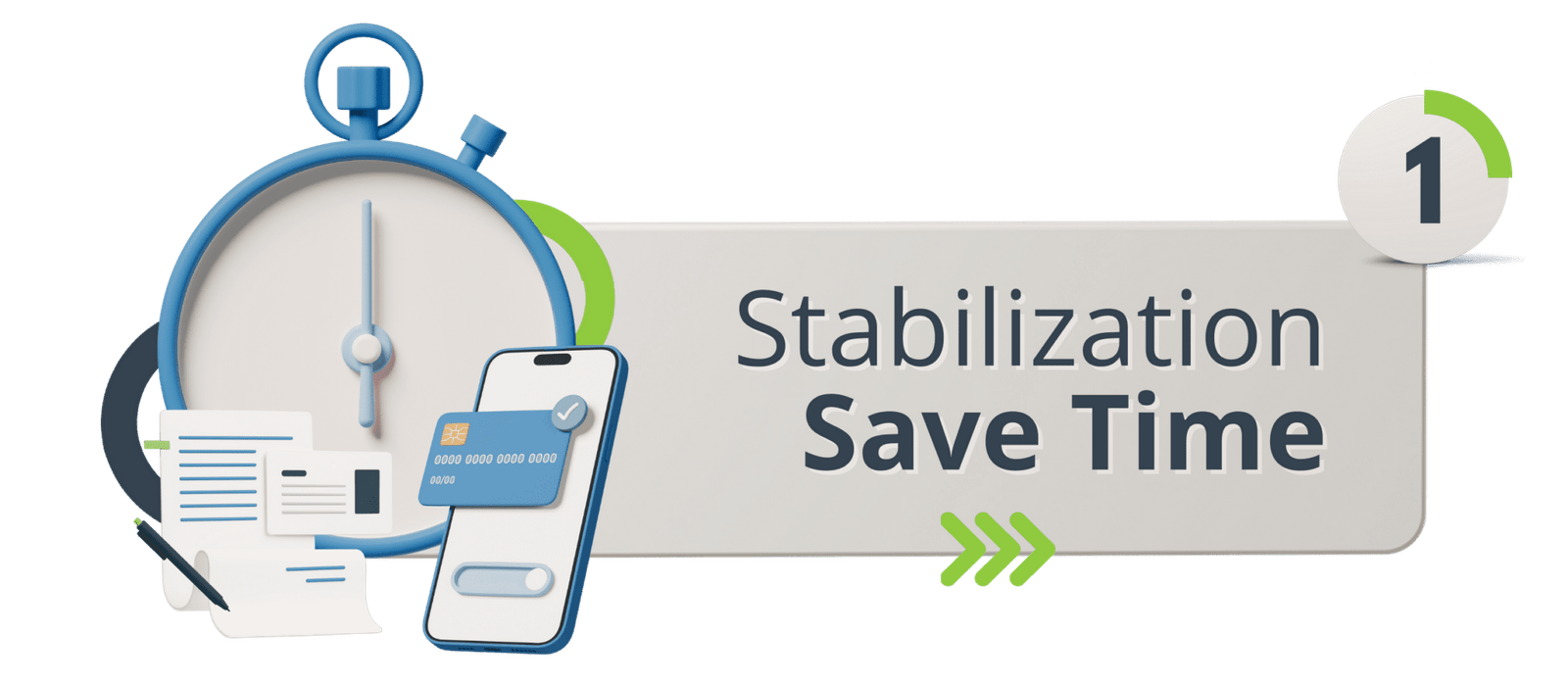
During the stabilization phase, our team will address any accounting clean-up tasks that need to be executed to stabilize your business. This includes organizing messy accounting records, reviewing prior tax fillings, and setting up efficient bookkeeping and reporting systems.

In this phase, we collaborate closely with you to design a tax strategy that effectively reduces your tax burden. We also focus on streamlining your accounting processes by analyzing your current systems and introducing tax optimization strategies.
The Strategize stage is where your business begins to see the tangible benefits of strategic financial planning. With Fusion CPA’s expertise, you can look forward to not just growing your business but doing so in a financially smart and tax-efficient manner.

At Fusion CPA, we understand that every business has its unique set of challenges and aspirations. That’s why our CFO Advisory service is designed to be more than just financial guidance – it’s a partnership to propel your business toward its unique goals.
Our team of seasoned CFOs brings a wealth of experience and a personalized approach to help your business not just grow, but scale in a way that aligns with your vision.

Both individuals and businesses are required to file 1099 forms for each recipient that receives $600 or more in a tax year. Here are the different types of 1099 forms you may be required to file.

Looking at forming an LLC? There are a number of ducks you need to have in a row to be able to do so. We take a look at some of the factors to take consider when launching your LLC entity.

Learn what employers must do before the 2025 tax season to Stay compliant with the IRS’s new tip and overtime deduction rules under the One Big Beautiful Bill Act.

Form 1120-S is a tax form used by S corporations to report the flow-through of items from the corporation to its shareholders.

Tax Form 1065 is filed annually by Partnerships and LLCs to report the income, deductions and credits to the IRS. Get more information on the submission of this form.

We unpack the most significant changes introduced by the One Big Beautiful Bill, and how they impact you and your business.